
Towards a competitive European AI ecosystem
4 mins read
Reinforcing the European leadership in AI is one of the objectives of the recently released AI Continent Action Plan. To meet this goal, cooperation and a seamless, integrated ecosystem combining AI Factories, Data Spaces and HPC resources is needed.
Training and development of AI models require access to vast data resources as well as powerful computing tools. The recently established 19 European AI Factories and 13 AI Factory Antennas will be key instruments for bridging the gaps between compute and data. They will leverage the compute resources available in the EuroHPC and support their connection to the Common European Data Spaces (CEDS) through Data Labs.
Data labs are specialised facilities that bring together Common European Data Spaces (CEDS), data holders, AI ecosystem and domain-specific data ecosystems. It is a novel concept unveiled by the Commission, introduced in the EC’s Apply AI Strategy, and further described recently in the Data Union Strategy. Data labs are still shaping, but when operational, they will i.e., for example pool data, facilitate data access as well as bridge AI ecosystems and data spaces. The very first data labs will be piloted and integrated into AI Factories and serving as components of them.
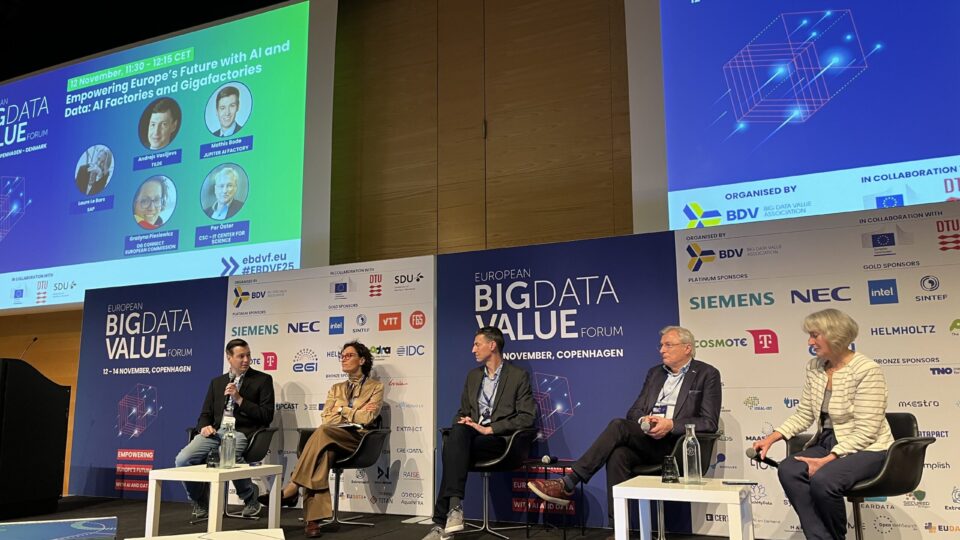
AI Factories, data and compute resources were at the centre of discussion at the European Big Data Value Forum (EBDVF) 2025, organised in Copenhagen on 12-14 November 2025.
AI Factories, Data Spaces and Data Labs complete each other
The European engines for AI are the AI Factories, one-stop shops that support the entire AI life cycle, combining high-end computing infrastructure and facilitating access to data and the whole AI ecosystem. Many of these computing facilities are already connected to existing CEDS, such as the European Open Science Cloud (EOSC), which supports the AI Factories in achieving Data interoperability for research data.
One of the sessions at the EBDVF focused on the AI Factories, their work on data, and the upcoming Data Labs. Heidi Laine, Senior Specialist at CSC, and the lead for LUMI AI Factory data service development, gave a presentation on the Dataset-as-a-Service concept and plans for a Research Data Lab. The session also featured presentations from other European AI Factories, the EC, the EuroHPC JU, and data spaces.
Data interoperability and seamless access are key considerations for LUMI AI Factory also. Currently, the main data offering in the LUMI AI Factory is datasets-as-a-service, providing AI developers a wide and easily accessible selection of AI-ready datasets, and data providers with a way to share their data in a secure environment. LUMI AI Factory will also establish a Research Data Lab to facilitate industry access to research data. The Research Data Lab will work closely with the EOSC Federation and European research and data infrastructures. Other focus areas for LUMI AIF Factory on the data side include manufacturing, communication networks, and life sciences, areas that will also see some contributions from LUMI AI Factory.
Federated approach and collaboration are the cornerstones of a functional ecosystem
Per Öster, Director of Advanced Computing Facilities at CSC – IT Center for Science contributed to the event as a panelist in a plenary session on “Empowering Europe’s future with AI: AI Factories and Gigafactories“. The other contributors to the session involved actors across Europe, working closely with AI Factories, such as the Commission, JUPITER AI Factory, Tilde, and SAP.
In the session, the discussion centered around Europe’s goal to be at the forefront in combining sovereign AI, Data and Computing, and through these, Europe should lead the AI powered evolution – Europe’s main specialty in achieving these goals is the network approach. Moreover, the only way to move forward is to ensure meaningful cooperation with the main stakeholders.
Great success stories from collaboration already exist, as Per Öster puts it: “For the LUMI supercomputer, it is not a new exercise to work closely with industry, but with the LUMI AI Factory the collaboration is expected to happen with unprecedented intensity and scale. If we think of the AI Factories as a platform for R&D and innovation for SMEs and other industries then the planned Gigafactories will be the commercially based platform where they can scale up their services and bring them to their customers. Together the AI Factories and Gigafactories will accelerate the process of going from AI-innovation to AI-implementation.”
Collaboration with other linked initiatives, such as European Digital Innovation Hubs (EDIHs), and Testing and Experimentation Facilities (TEFs) will also be continued in LUMI AI Factory to explore synergies.
An interoperable, federated approach to data and computing, coupled with intense collaboration is key to build functional AI Ecosystem and Europe’s AI leadership. The technical prerequisites for federating resources, as well as mechanisms to support the cooperation, create these opportunities.
Authors: Elisa Halonen CSC, Per Öster CSC, and Heidi Laine CSC
Photo: Elisa Halonen, CSC