
What is LUMI AI Factory’s Artificial Intelligence expert consultation?
6 mins read

Artificial Intelligence (AI) expert consultation is a new service offered by the LUMI AI Factory to help organisations tackle advanced AI development challenges on the LUMI supercomputer. Expert consultation means interactive, in-depth support for complex AI challenges, and is primarily aimed at industrial customers. The LUMI AI Factory consultation is open and free of charge for startups and SMEs from the EU Member States and countries associated with the Horizon Europe programme.
This blog post illustrates example projects, the consulting process lifecycle, and how to get started. This blog post is part of a series: See also the previous blog post on “Why supercomputing and LUMI?“.
Examples of AI expert consultation projects
Some example projects that have already received AI expert consultation:
- Adaptation to the LUMI supercomputer: A customer has previously used a cloud environment. We guided the installation and adaptation of existing AI pipelines to the LUMI supercomputer.
- Training frameworks: The customer wanted to upscale their AI efforts by using more computational resources. We assisted with selecting suitable frameworks for training machine learning models, and making sure that they run efficiently on the LUMI supercomputer.
- Introduction to AI: The customer knows the domain, such as automatic speech recognition or molecular screening, and we consult with our AI expertise.
- Regulatory guidance: We help customers with questions about Trustworthy AI and relevant regulations like the EU AI Act and the GDPR.
- Data requirements: The customer requires help with their data. We provide guidance on the LUMI AI Factory tooling for Dataset-as-a-Service and data streaming, as well as on handling sensitive or confidential data.
The involvement of AI experts varies depending on the needs of the project.
AI expert consultation lifecycle
The AI expert consultation can be split into four phases as illustrated in the following figure. The first two phases can usually be completed within two weeks, while the length of the execution phase depends on the project. Throughout all phases it is important to keep the deployment in mind.
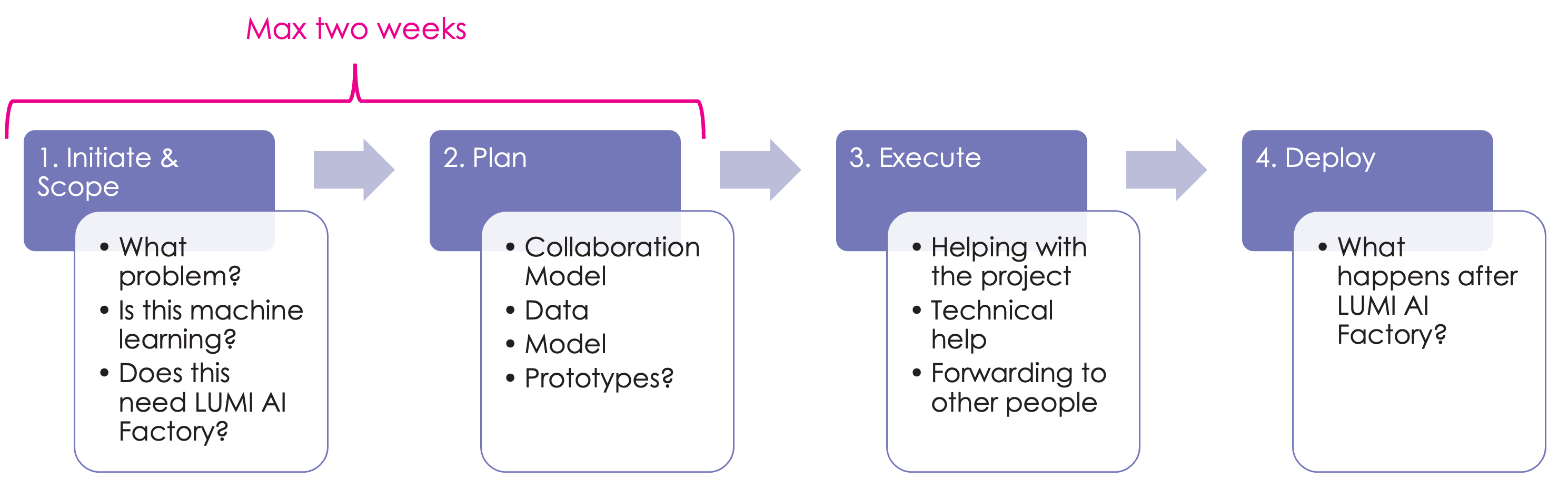
1. Initiate & scope: Defining the problem and feasibility
Every consultation begins with an initial meeting where LUMI AIF experts work with the customer to determine if a project is ready to proceed. The goal is to establish clarity before any technical work begins. Key questions include:
- What problem are we solving – and why? This helps to understand the context of the project.
- Is machine learning the right approach? Perhaps other approaches are more fitting.
- Is the LUMI supercomputer the right infrastructure? We can suggest a suitable platform.
- Are the available data, skills, and resources sufficient for feasibility? How mature is the idea, and how can LUMI AI Factory experts help to enable a feasible project?
As the LUMI AIF consultants are funded by the European Union and the LUMI AI Factory consortium countries, their key objective is to enable startups and SMEs to build and scale competitive AI solutions, even if that means recommending solutions outside of the LUMI AIF or not involving AI, but more traditional approaches.
2. Plan: Strategising data, models, tools, and prototypes
Once a project is initialised, it moves to a focused planning phase. Key considerations:
- Data: Data quality and availability often determine whether an AI project can succeed.
- Modelling strategy: Fine-tuning an existing model, training a model from scratch, or using classical machine learning methods.
- Other LUMI AIF services: Are other services from LUMI AIF useful for the consultation case? Examples include tailored customer training and Dataset-as-a-Service.
- Prototypes: Should prototypes or Proofs-of-Concept (PoCs) be built? These provide rapid learning without over‑committing to a full production architecture.
- Resourcing: How much involvement is required and how involved can LUMI AI Factory consultants be?
3. Execute: Iterative development, evaluation and benchmarking
In this stage, the project moves from planning to hands-on development and experimentation. This stage is iterative, with refinement cycles until the model meets its requirements. It includes the following aspects:
- Ensuring data remains clean, representative, versioned, and well‑managed.
- Building, fine‑tuning, or training machine learning models—including distributed training for large models when needed.
- Ensuring models are ready for real‑world integration, accounting for latency, throughput, and reliability.
- Conducting rigorous evaluation and validation for aspects like accuracy and precision, but also fairness and bias, toxicity, and computational efficiency.
- Consulting regarding regulations like the AI Act or GDPR.
Success story examples
In previous cases, LUMI experts have helped set up customers’ software environment on the LUMI supercomputer during an intense one-day workshop (see the success story from the Finnish satellite company ICEYE). Read also other success stories.
4. Deploy: Turning a prototype into a production-ready system
The closure stage focuses on operationalising the results so they can be used reliably beyond the consultation period. This includes moving from the RDI phase on the LUMI supercomputer to a production environment, such as a commercial cloud service provider. This includes the following aspects:
- Consulting on requirements regarding compliance, performance, and cost.
- Adapting the AI software environment to allow for a smooth transition from the LUMI supercomputer.
How to get started with a consultation?
Reaching out is easy: You can contact the LUMI AI Factory experts by filling out a contact form, and your inquiry will be directed to the appropriate AI specialists!
To learn more about what free of charge access means and who is entitled to it, take a look here.
Other types of user support
Apart from AI expert consultation, projects on LUMI can also receive user support via:
- LUMI User Support team: Focuses on onboarding, troubleshooting, user documentation, training events and hackathons, software stack development, as well as advanced level support such as benchmarking, porting and optimization. LUMI User Support is available to all LUMI users via the ticket system and monthly online user coffee breaks.
- EPICURE offers a wide range of support services to all the EuroHPC JU users (= members of a EuroHPC JU project):
- code porting and project enabling
- performance improvements, benchmarking, and performance analysis
- code optimization: intra-node optimization, inter-node optimization and scaling-out
- accelerator porting and optimization support (AMD GPUs)
Read also other blogs in the series:
Trustworthy AI: Turning compliance into competitive advantage
AI agents and agent infrastructure on LUMI
Local agents, remote brains: connecting OpenCode to LUMI
Written by

Marlon Tobaben
Machine Learning Specialist at the LUMI AI Factory

Markus Koskela
Development Manager at the LUMI AI Factory

Kalle Huhtala
Senior Project Manager at the LUMI AI Factory