
From small to large with LUMI supercomputer: a computer vision model for sports spectators
7 mins read

A Finnish startup BC Bertenex set out to expand its operations and service portfolio with AI applications. Drawing on its strong mobile development background, the company began exploring whether AI could run natively on mobile devices as an Edge AI solution for sports spectators. In early 2026, things truly began to move forward when the LUMI supercomputer was harnessed for AI development. What started as a small startup began to grow into something much larger as development of its own computer vision model got underway. The AI model also opened new collaboration opportunities for Bertenex, and it became apparent that the model’s capabilities could serve research purposes and support other SMEs as well.
The startup, founded in 2022, was established by Ville-Matti Hakanpää, who has 25 years of experience in software development and a keen interest in generative AI. Hakanpää also has more than 30 years of experience as a juniorfloorball coach . In Rauma, Finland, attendance at floorball matches was often quite low, which led him to wonder how to make the sport more engaging for spectators.
– We set out to solve the decline in sports spectatorship and the difficulty of following the game. This gave rise to the vision of ‘clickable players.’ What if a spectator could point their phone camera at the field, click on a player, and instantly see real-time information and statistics about them? Would that make watching the game more engaging? Hakanpää recalls thinking.
The problem was that existing computer vision models had complicated licensing terms.
– For an SME, building on top of a commercial off-the-shelf model is a massive business risk. We needed our own clean, mobile-optimised foundation model. Training such models in commercial clouds at per-minute pricing was completely out of the question, and a home computer with a six-gigabyte graphics card was useless for this purpose. We needed massive computing power, Hakanpää explains.
Access to LUMI enabled product development
Hakanpää says that in January 2026 he attended a wellbeing technology trade fair in Pori, Finland, where he visited the LUMI AI Factory exhibition stand. After a spontaneous discussion, things began moving quickly. It was a rather bold step for someone with no previous experience in high-performance computing.
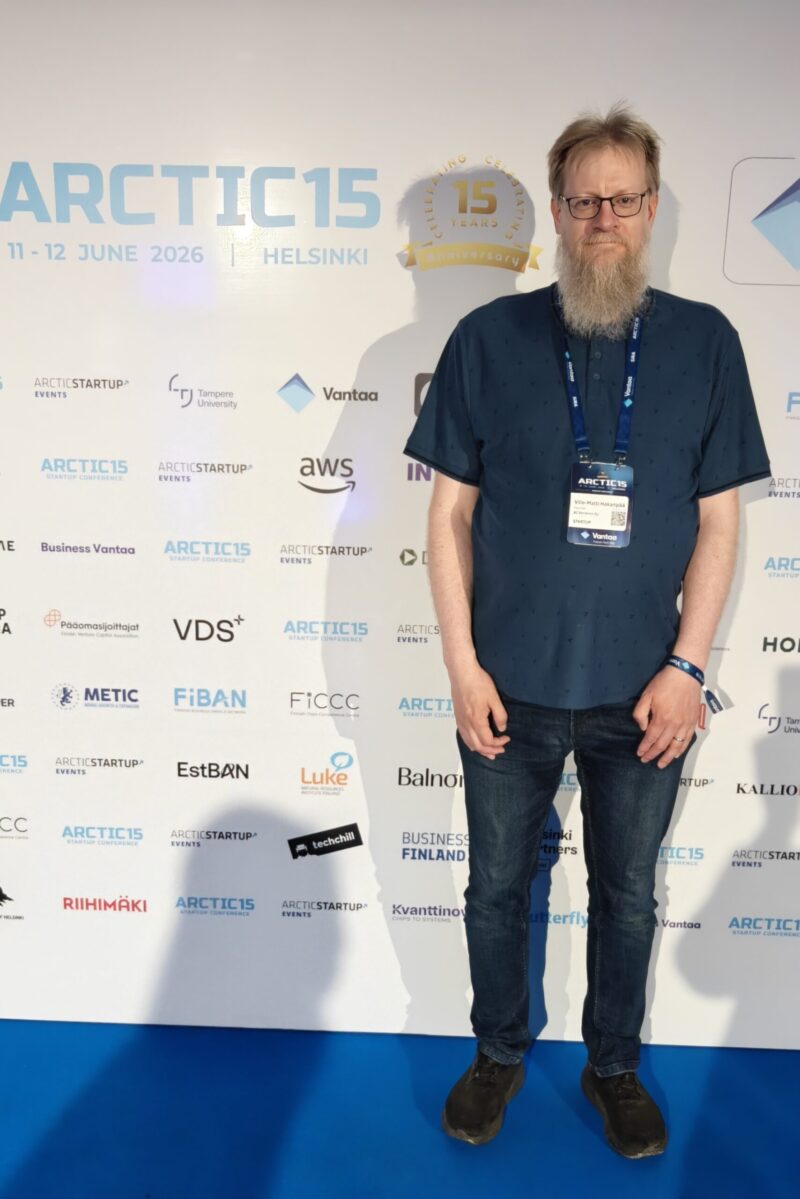
– I’ve been writing code for 25 years and running models on my own devices and in standard cloud environments, but LUMI was my first encounter with real high-performance computing (HPC), says Hakanpää.
Following this meeting, Bertenex started the Try&Buy project intended for Finnish SMEs and received a trial allocation of 1,000 GPU hours from LUMI. Reality hit quickly.
– We burned through all one thousand hours in three days training a 10-million-parameter model. We simply ran out of GPU hours, Hakanpää says.
The experts at the LUMI AI Factory also noticed Bertenex’s momentum and encouraged the company to apply for LUMI capacity through the EuroHPC JU AI Factory Call under an accelerated process.
– Our company was granted as many as 50,000 GPU hours, which we are now using to develop models with 10, 25, and 50 million parameters, Hakanpää says enthusiastically.
LUMI experts helped with the onboarding
Getting started was fairly straightforward, but they still had to learn high-performance computing principles.
– This isn’t a direct replacement for a production environment or a RunPod environment where you simply type installation commands and start running models on a supercomputer. For example, uploading more than seven million training images into the file system required understanding an entirely different compression logic, Hakanpää explains.
LUMI’s documentation, GitHub repository, and short training sessions were a major help, along with the team’s own experience. According to Hakanpää, they received extremely valuable support from LUMI experts when transitioning to EuroHPC resources, particularly when combining their original Try&Buy credentials, new projects, and access rights. LUMI experts helped identify the critical setup components.
Models to be released openly
According to Hakanpää, the LUMI AI Factory makes work of this scale possible in the first place. Without LUMI and EuroHPC resources, training their own computer vision models would be economically impossible.
– For our customers, such as sports clubs and spectators, this means we can bring AI solutions directly into their pockets. While competitors are considering installing expensive camera infrastructures in stadiums, our Edge AI model enables the service to run on the spectator’s own device. This makes the technology accessible even to grassroots organizations and small clubs, which is extremely important for widespread adoption, says Hakanpää.
Bertenex’s sports application also supports grassroots sports by providing clubs with a completely new digital platform for advertising and player visibility.
– More broadly, we are solving the licensing trap that affects the software industry as a whole. We are not keeping these models to ourselves. All mobile-optimized foundation models enabled by EuroHPC computing resources, with 10, 25, and 50 million parameters, will be published on GitHub, along with training materials as open source. Thanks to one Finnish startup and LUMI’s resources, the entire global developer community will gain access to safe and open mobile AI models. This also directly supports European AI sovereignty, Hakanpää emphasises.
Advancing sustainable product development
The Edge AI technology developed by Bertenex is inherently sustainable. The models run directly on the end device, such as a spectator’s phone, eliminating the need to continuously transfer large amounts of data to the cloud and significantly saving energy.
– LUMI’s environmental friendliness is also a very positive aspect and aligns well with our own values. It is impressive that such enormous computing power can be produced in an environmentally sustainable way, says Hakanpää.
Pilot launch planned for autumn
The company’s next major milestone is piloting its sports application with floorball team Rauman SalBa during autumn 2026. Bertenex is also seeking seed funding to scale its operations, and its collaboration with LUMI adds considerable credibility to those efforts.
– We sincerely hope that our cooperation with the LUMI AI Factory will continue and that we will keep receiving access to LUMI computing resources. Now that we have become familiar with the system and its incredible possibilities, we want to continue training our own models. With LUMI’s enormous resources available, the opportunities feel limitless. In the future, we hope to use the expertise we have gained to help other companies harness high-performance computing to develop their own AI models, Hakanpää envisions.
– The specific needs of small and medium-sized enterprises are extremely valuable and educational for us. We hope to combine our expertise and provide competitive domestic and international solutions for the software and product development needs of SMEs as high-performance computing and AI development continue to advance rapidly, says Dan Still, Development Manager responsible for business partnerships at CSC.
An important takeaway from this customer story is that startups can access computational and financial support, as well as various business development mechanisms. Bertenex has also received development support and guidance from EDIH (European Digital Innovation Hub). These regional one-stop service centers are supported by the European Union under the Digital Europe Program and help SMEs and public sector organisations adopt advanced digital technologies, artificial intelligence, and cybersecurity solutions.
– Robocoast EDIH’s role was to help the SME identify the right path forward, connect with experts, and reduce the risks associated with AI development, says Kati Kiljunen of Robocoast.
– The LUMI supercomputer provided the resources for development, while the LUMI AI Factory provided expert support for AI development and use of LUMI. Additional resources for further development were secured through the EuroHPC JU AI Factory calls. The value was created through the transition process and the chosen approach. EDIH, LUMI, the AI Factory, and EuroHPC each played their role, and luck also had its part to play, summarises Tiina Leiponen, Account Manager at CSC.
Author: Tiina Leiponen, CSC – IT Center for Science
Image on top: Adobe Stock