
Poutanet advances 4G and 5G telecom innovation using LUMI AI Factory Services
4 mins read
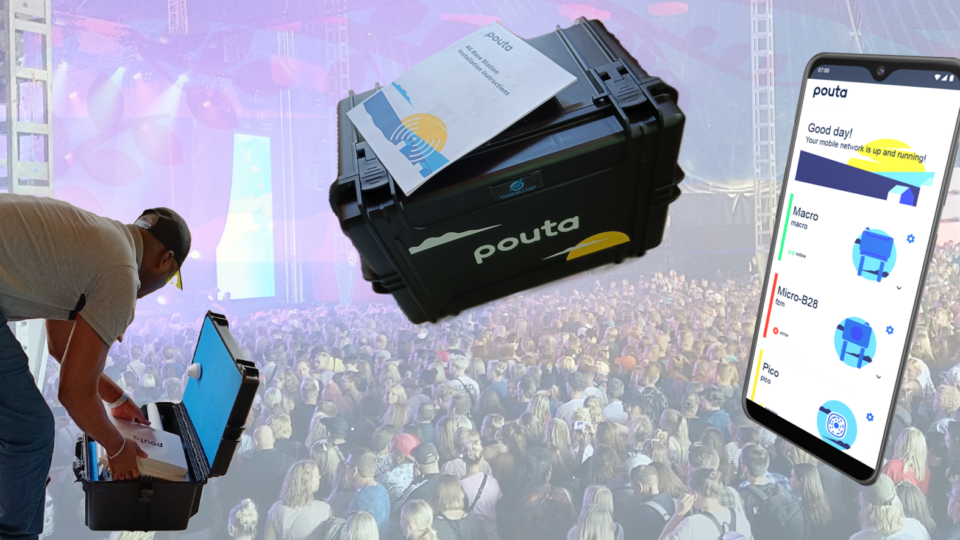
Reliable connectivity is essential in high-demand environments such as live events, emergency
response operations, and disaster situations. Poutanet, a Finnish provider of private mobile
networks, develops portable 4G and 5G solutions that can be deployed rapidly wherever
connectivity is needed. Its offerings range from a compact “network-in-a-box” solution and
larger cell-on-wheels systems to a simplified operations platform that enables even non-telecom personnel to manage networks efficiently.
As temporary network deployments become increasingly complex, Poutanet is exploring AI-powered tools to simplify operations, accelerate troubleshooting, and reduce operational complexity.
– Incorporating AI into current tools is an obvious approach, says Martti Ylikoski, Managing
Director at Poutanet.
At this stage, the company turned to the services of the LUMI AI Factory. AI-powered tools are
being developed to make the product as user-friendly as possible for the end user.
Poutanet is testing AI enhancements to its Sunshine management solution. These include a
troubleshooting wizard using a dynamic retrieval augmented generation (RAG) and autonomous
agents with OpenClaw. Over time, these and more AI features will be needed in commercial
deployments.
With LUMI, hardware is no longer a limiting factor
When testing openly available large language models (LLM) with existing training data, the
developers noticed gaps in domain specific topics that could not easily be fixed by adding
documentation. To address this, Poutanet decided to fine-tune their own LLM using proprietary
materials and the LUMI supercomputer for model tweaking and data preparation to receive the
best possible outcome.
– With using LUMI supercomputer, we are no longer hardware limited but can run many more
fine-tuning iterations compared to using our own servers. In other words, we wanted to put the
constraint on our side in our ability to generate and gather enough training data, Ylikoski
continues.
The chatbot platform is developed in Python and runs on LUMI’s high-performance AMD GPU
infrastructure. It combines Streamlit for the user interface, FastAPI for backend services, Ollama
for running AI models locally, and LlamaIndex for retrieving relevant information from
knowledge sources. This allows the chatbot to provide accurate, context-aware responses for the
user while integrating with external systems and live data sources.
Training, expert support and AI computing from the LUMI AI Factory
To accelerate development, Poutanet combined several services offered by the LUMI AI
Factory. Through the Try & Buy service, the company was able to explore and validate AI use
cases before committing to larger-scale deployment. LUMI AI Factory’s training and expert
support helped the team build the necessary skills and identify best practices for developing
domain-specific AI solutions.
The project also benefited from access to LUMI’s advanced AI computing resources, which were
used for data processing, model fine-tuning, and testing. This enabled faster experimentation
cycles and removed infrastructure limitations, allowing Poutanet to focus on improving model
quality and preparing the solution for real-world use.
Prototype for technical support queries in use
Poutanet is currently conducting its first internal live validations, aiming to reduce resolution
time while also reducing cognitive load and stress for users. Initial results are promising, but the
development is still ongoing.
The project has delivered a working AI assistant prototype for technical support queries, with
early tests showing potential to streamline network setup. Two prototype variants are currently
under internal development and evaluation. A production pilot is planned for autumn 2026, with
the aim of validating the solution in a real operational environment and laying the groundwork
for future AI-assisted operations.
Leveraging European AI infrastructure such as the LUMI AI Factory enables organisations to
develop and deploy AI solutions while maintaining greater control over data, skills, and
technology.
– Using the LUMI supercomputer for training local models keeps critical technology stack
elements in Europe, helps build local AI skills and reduces risks for leaking competitive data
sets. Local models also provide our customers with greater data privacy and sovereignty,
eliminate API costs, and ensure uninterrupted operation. On the other hand, cloud-based frontier
models offer the highest level of capability. Ultimately, it is a trade-off, and our role is to give
customers the flexibility to choose the approach that best suits their needs, says Ylikoski.
As the project progresses, Poutanet demonstrates how the LUMI AI Factory can support
innovation in telecommunications through AI-assisted network operations while maintaining
data sovereignty and operational resilience.
Author: Liisa Haltia, CSC – IT Center for Science
Images: Poutanet