
When one computing method is not enough
5 mins read
In hybrid computing, a supercomputer, artificial intelligence, and a quantum computer work together to solve problems that none of them could tackle alone. Hybrid computing has been available in Finland since 2022, when the country’s first quantum computer was connected to the LUMI supercomputer.
We all use hybrid computing
People learn the principles of hybrid computing as children, even if they never use the term itself. We first count on our fingers, then turn to pen and paper, and eventually use a calculator in one form or another. Different tools are used side by side, with each task assigned to the method best suited to it.
Scientific computing has evolved in much the same way. Supercomputers have been solving computational problems far beyond human capability for more than 60 years, and over the past three decades their processing power has increased a millionfold. This almost unimaginable growth forms one of the foundations of modern artificial intelligence. Although the concept of AI was developed in the 1950s, only the dramatic increase in computing power made it possible to process data at a scale that enabled a qualitative leap in AI capabilities. Combined with the vast amounts of data accumulated on the internet, this gave rise to technology that is transforming the world.
AI has even changed the way science itself is conducted. In many modelling problems, it is no longer necessary to solve every equation individually. Instead, AI can discover shortcuts. By learning from massive datasets, whether historical observations or data generated through traditional simulations, AI can predict, for example, the weather in minutes rather than hours, often with equal or even greater accuracy.
There are, however, problems for which AI cannot find reliable shortcuts. Traditional high-performance computing, where equations are solved directly, will continue to be essential. And then there are challenges for which even future supercomputers will struggle to provide sufficiently reliable answers, because the computational effort required grows exponentially with the size of the problem. These require something entirely different.
Quantum computing alongside supercomputing and AI
The challenge was recognized early on. Nobel Prize-winning physicist Richard Feynman famously summarized it in 1981:
“Nature isn’t classical, dammit, and if you want to make a simulation of nature, you’d better make it quantum mechanical.”
Feynman was referring to solving the equations of quantum mechanics, a task that is often insurmountable slow for conventional computers. While the subject may sound esoteric, quantum phenomena underpin many familiar technologies, from solar panels to the non-stick properties of Teflon.
A quantum computer harnesses these same phenomena for computation. Instead of relying on the binary system created by humans, where ones and zeros are manipulated in computer memory, quantum computing is built on nature’s own “operating system.” Its qubits, the fundamental units of quantum information, can exist in combinations of zero and one and can become interconnected. Computation manipulates these combinations so that incorrect possibilities cancel each other out while correct ones are reinforced, somewhat like waves interacting. In other words, quantum computing offers an entirely different way of performing calculations. For certain problems it can be dramatically more efficient, while for others it may be completely unsuitable.
Hybrid computing is about choosing the right method for the right task, much as a person chooses between fingers, pen and paper, or a calculator. Nearly every modelling problem consists of components that are best approached differently, whether the priority is efficiency, reliability, or energy consumption. A supercomputer performs simulations. AI learns and makes predictions. A quantum computer tackles calculations that conventional computers cannot handle efficiently because of their complexity, but which are well-suited to quantum logic.
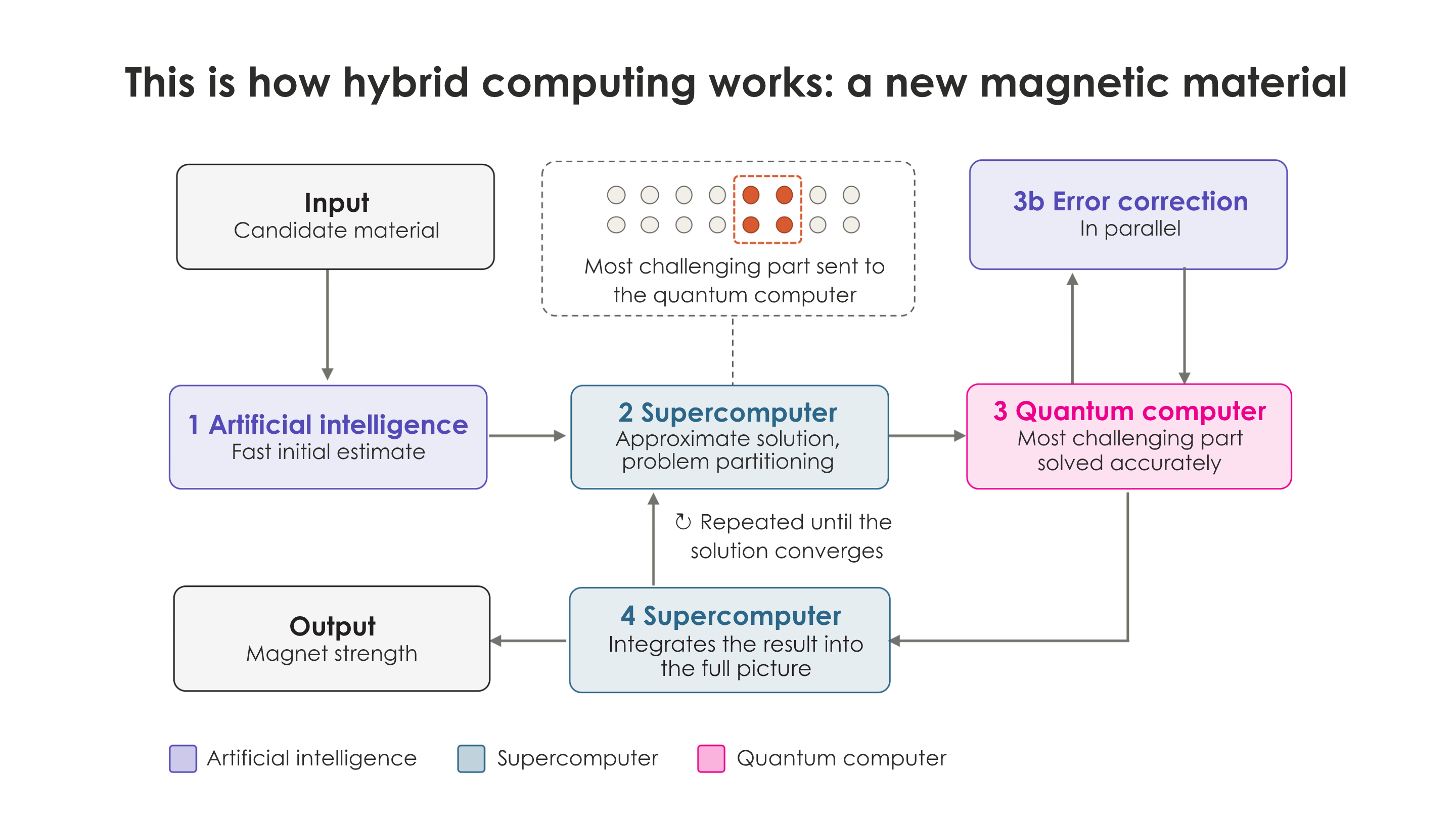
The strength of a wind turbine magnet arises from the collective behaviour of electrons, which is difficult for conventional computers to calculate.
- AI quickly estimates the material’s electronic structure.
- A supercomputer refines the estimate using an approximate solution of the Schrödinger equation and isolates the most challenging part of the calculation.
- A quantum computer calculates that most challenging part more accurately. 3b At the same time, AI identifies errors in the quantum computer’s calculations so they can be corrected.
- The supercomputer incorporates the result into the model of the entire material. Steps 2–4 are repeated until the result converges.
Finland at the forefront of hybrid computing
As part of the national FiQCI quantum computing infrastructure, VTT’s Helmi quantum computer was connected to the LUMI supercomputer in 2022. Finland thus became one of the first countries in the world to integrate a quantum computer with a supercomputer. Since then, LUMI has also been connected to VTT’s Q50, Aalto University’s Q20, and the pan-European VLQ quantum computer located in the Czech Republic.
More is on the way. At the time of writing, the national 150-qubit Q150 quantum computer, built by IQM, has just been unpacked at VTT’s facilities in Otaniemi. Current quantum computers, however, still make too many errors to solve practical problems better than conventional machines. This is why the next crucial step is LUMI-IQ, which will be deployed at CSC’s data center in Kajaani as part of the LUMI AI Factory initiative. LUMI-IQ will introduce more fault-tolerant qubits while also becoming an integral component of the European Union’s largest AI Factory.
Finnish researchers and companies already have access to a next-generation computing environment that allows them to explore and prepare for the future. A future in which supercomputing, artificial intelligence, and quantum computing work together to solve challenges across the spectrum, from the mysteries of the universe to the magnets in wind turbines and the battery in the smartphone carried in your pocket.
Written by Mikael Johansson, Director of Technology Programmes at CSC
This article was first published in Finnish in the November 2026 print issue of TIVIA News.